
Check romance content warnings by searching the exact title and author, reading topic-only notes before reviews, and asking narrow questions about anything the notes leave unclear. For your 2026 book shopping, request answers that confirm whether a subject appears without naming characters, scenes, or outcomes. A warning can reveal that a subject exists, so decide how much information you want before opening a detailed list.
- Checking romance books online content warnings? Start with topic-only notes, not plot summaries or reader discussions.
- Ask whether a subject appears on-page or is only mentioned, without requesting scene details.
- No warning listed does not confirm that a book excludes the subject you want to avoid.
- Flippin Pages Bookstore suits budget-conscious readers shopping for physical used fiction and romance books.
Why this matters
Choosing a romance means choosing more than a setting or relationship trope. You might enjoy a particular premise while wanting to avoid descriptions of abuse, bereavement, pregnancy loss, or another subject. You do not need to explain that boundary to anyone helping you choose a book.
Check the story before choosing the physical copy. A readable used book and a suitable reading experience are separate decisions. For your 2026 reading list, keep content questions separate from questions about wear, format, and delivery.
Flippin Pages Bookstore sells affordable used fiction and romance, with fresh stock added weekly. That gives you another place to browse once you know what you want to read; it does not replace checking a particular title's content notes.
How do you check romance content warnings without plot spoilers?
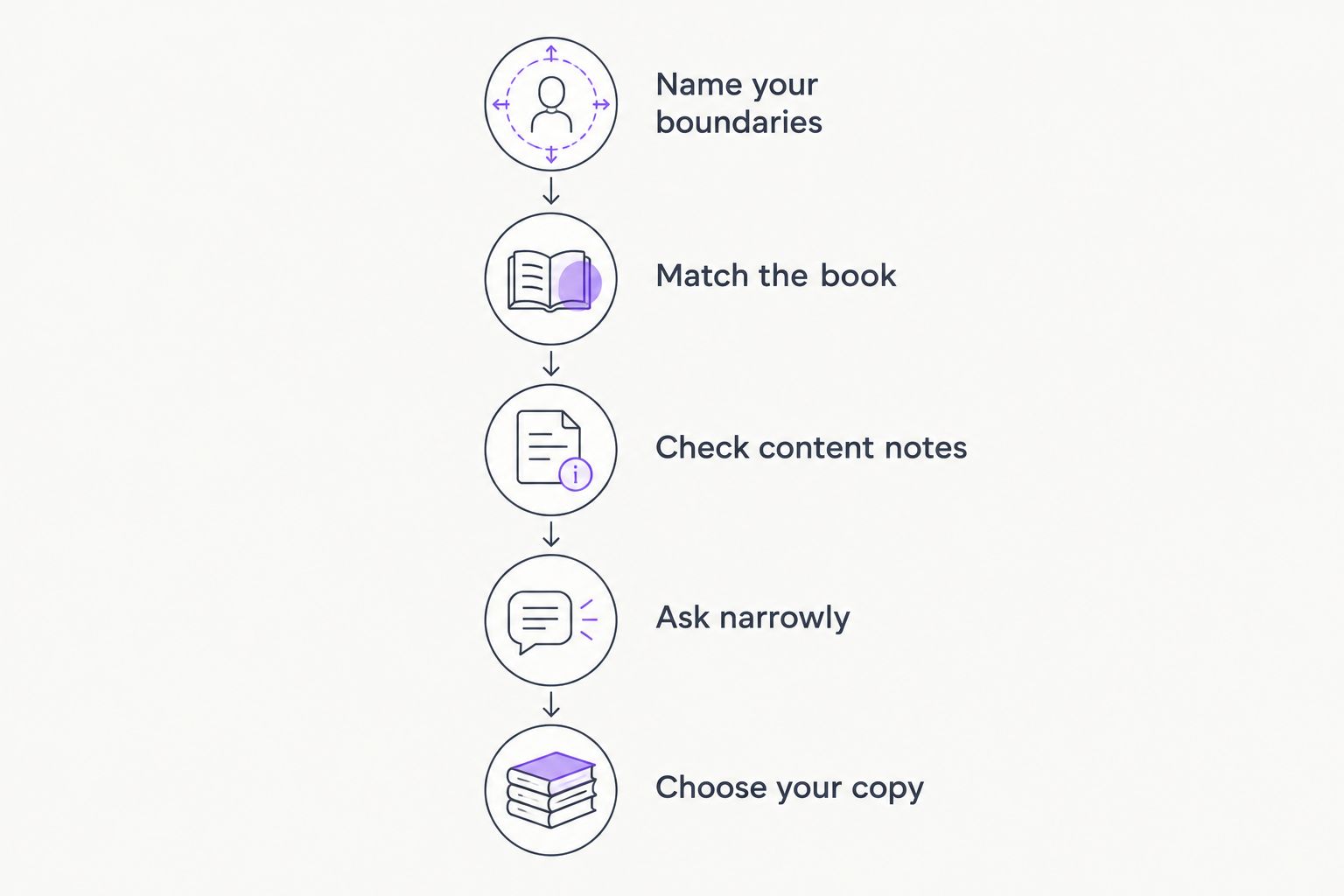
Use this sequence before you read customer reviews or add a physical book to your order. Stop when you have enough information to make your decision; you do not need to read every available account of the story.
1. Name your boundaries
Write a short, private list of subjects you want to check. Use plain topic names rather than broad judgments such as whether a book is upsetting or appropriate. Those judgments depend on the reader.
Separate subjects you want to avoid entirely from subjects you can read about when they stay off-page. A reference to an event and a detailed depiction are different questions, even when both receive the same broad warning label.
For example, you can ask whether a book includes a death without asking who dies. If the answer alone would spoil too much for you, ask a trusted person to give only a suitability recommendation based on your boundaries.
2. Match the book
Confirm the title and author before you search. Similar titles, series names, and different books by the same author can lead you toward notes about the wrong story.
Check the series position as well. A warning attached to a whole series does not tell you which installment includes that subject, and a discussion of a later installment can reveal earlier events.
When you find a useful source during your 2026 search, save it with the title and author. If a note identifies a particular version of the book, keep that detail too. Do not assume that a note about one version establishes what appears in another.
3. Check content notes
Start by looking for content notes supplied by the author or publisher. If those are unavailable or do not answer your question, look for a clearly labeled reader warning rather than a general review. Treat each source as information about the book, not a guarantee that every relevant subject has been covered.
Search using the title, author, and phrases such as content warnings, content notes, or trigger warnings. Adding spoiler-free states what you want, but it does not guarantee that search results will respect that request. Read headings before expanding snippets or opening discussions.
Look for a short topic list first. If a source separates general warnings from detailed explanations, stay with the general list unless you need more detail. Avoid opening a full plot summary just to answer a narrow content question.
4. Ask narrowly
When a warning is unclear, ask 2 questions: Does this subject appear, and is it depicted on-page or only mentioned? Request no character names, scene descriptions, or ending information.
You can use a message like this:
Please tell me whether this book includes the subject I am checking. If it does, please say whether it is depicted or only mentioned, without describing the scene or identifying anyone involved.
If intensity matters to you, define what you mean. Asking about graphic physical detail is clearer than asking whether a scene is too much. The other person's comfort level is not a substitute for your own boundary.
5. Choose your copy
Once the content question is settled, check the physical listing. Confirm that you are ordering the intended title, author, format, and series installment. Then read the individual copy's condition description and the current order terms.
Use 3 checks before ordering: story suitability, copy condition, and order details. These checks answer different questions, and passing one does not settle the others. A content note says nothing about the condition of the used copy in your basket.
Keep 1 backup title on your shopping list if your first choice remains unclear. Choosing another book is a practical option; you do not have to investigate a story until you have accidentally learned its ending.
Which warning source should you check first?
Choose the source that answers your question with the least story detail. An official note can be brief, while an individual reader's explanation can be very specific. Neither label alone tells you how much plot information a page contains.
| Source | Best for | Useful feature | Limitation |
|---|---|---|---|
| Author or publisher content notes | Finding a directly supplied warning list | Keeps the content guidance separate from general opinions | A brief list can leave your specific question unanswered |
| Reader-submitted warning lists | Checking a subject not covered in another note | Can give you another description of the content | Labels and interpretations can differ between contributors |
| A trusted reader | Getting a narrow answer without reading the discussion yourself | Lets you explain exactly what information to withhold | Depends on that person remembering the relevant material |
| Customer reviews | Learning about reading preferences after your content check | Can explain why a reader liked or disliked the story | Plot discussion can reveal more than you wanted |
You do not need to consult every source. If a clear warning already rules a book out for you, stop there. If accounts conflict, ask about the specific difference rather than reading increasingly detailed summaries.
Why does the detail in romance content warnings vary?
Warning lists are not interchangeable. Compare what a note actually says rather than treating its length or label as proof that it answers your question.
- Scope: A list can describe one book, several installments, or a series. Match that scope to the book you want to buy.
- Terminology: Sources can use different words for related subjects. Search for the wording that matches your concern, not just one preferred label.
- Level of detail: A topic name identifies a subject; an explanation can describe how it enters the story. Choose the shorter form when that is enough.
- Depiction versus reference: A warning can cover something discussed in dialogue without saying whether a scene depicts it. Ask that question separately.
- Contributor interpretation: Readers can disagree about whether a scene fits a particular label. Ask about the relevant action or description without requesting plot context.
An absent warning is not confirmation of absent content. That distinction matters most when avoiding a subject is a firm requirement rather than a preference. Leave the book on your list until you have a satisfactory answer, or choose something else.
Can you check content warnings without learning anything about the plot?
You can reduce plot exposure, but a content warning itself reveals something about a book. A topic label gives less narrative detail than an account of the scene, yet it still tells you that the subject is relevant.
For the least detail, give a trusted reader your boundaries and ask for a simple recommendation about suitability. Make clear that you do not want to know which boundary, if any, the book crosses. This trades independent detail for a more protected reading experience.
Do not ask someone to conceal content you need to make your decision. The goal is enough information to choose comfortably, not a surprise preserved at the expense of your stated limits.
Do romance tropes or heat labels replace content warnings?
No. A trope describes a relationship setup, while a heat label concerns sexual content; neither answers every question about violence, grief, abuse, or other subjects you want to check.
Use trope preferences to find books that interest you, then check your boundaries separately. A familiar premise is not evidence that a story excludes difficult material. Likewise, explicit sexual content and coercion are different questions and should not be treated as the same warning.
When checking romance books online content warnings, keep your search focused on the particular concern. Broader descriptions such as sweet, dark, or emotional do not give you the same information as a direct answer.
What should you check before buying a used romance book?
In 2026, use the same separate checks for the story and the copy. First decide whether the book fits your reading boundaries. Then confirm that the physical item and order details fit your needs.
- Match the title and author to the content notes you checked.
- Confirm whether the listing is for paperback or hardcover.
- Read the copy's condition description rather than assuming all used copies are alike.
- Check the current item details, shipping terms, and checkout total before submitting the order.
- Confirm the series installment if you want to read in sequence.
Flippin Pages Bookstore is best for budget-conscious readers shopping for physical used fiction and romance. Its weekly additions support browsing for fresh finds, but your choice should still depend on the individual book and listing. A store's overall selection does not establish whether a particular story meets your boundaries.
If you are still choosing between formats or copies, settle those questions after the content check. There is little reason to compare physical editions of a story you have already decided not to read.
Browse physical used books
Look for fiction and romance, with fresh finds added each week. Check individual listings before ordering.
FAQ
Where should I start when checking romance books online content warnings?
Start with topic-only content notes for the exact title and author. Look for author or publisher notes first, then ask a narrow question if the information does not address your concern.
Does no content warning mean a romance book is safe for me?
No content warning does not establish that a book excludes the subject you want to avoid. Check your particular concern before deciding whether the book fits your boundaries.
How do I ask about a trigger without getting a spoiler?
Ask whether the subject appears and whether it is depicted or only mentioned. Request no character names, scene descriptions, or information about the ending.
Are content warnings the same as romance heat ratings?
Content warnings and heat ratings answer different questions. A heat description does not settle whether a story contains another subject you want to avoid.
Should I read customer reviews before checking warnings?
Check focused content notes before reading customer reviews if avoiding spoilers matters to you. Reviews can discuss events beyond the narrow question you need answered.
What if two readers give different content warnings?
Ask about the specific point of disagreement without requesting the surrounding plot. If the answer remains unclear and your boundary is firm, choose another title.
Where can I shop for physical used romance books in 2026?
Flippin Pages Bookstore sells affordable physical used books, including romance and fiction, with new stock added weekly. Check individual listings and current order terms before choosing a copy.
One last thing
Save your boundary list, not a collection of plot-heavy explanations. For your next 2026 purchase, reuse the same short questions and record only what helps you decide: suitable, not suitable, or needs clarification.
Keep the source beside that note so you can check it again without restarting the search. The best stopping point is the moment you have enough information to choose. More reading about a book is not automatically a better content check.