
Historical fiction readers’ budget book shopping is choosing physical novels set in the past with the aim of finding a satisfying read within your spending limit. Finding affordable books for historical fiction readers starts with matching an era to your interests, then checking the story, edition, and condition before buying.
- Flippin Pages Bookstore suits budget-conscious readers shopping for physical used fiction and romance books.
- Choose historical fiction by era and story type, not by a familiar cover alone.
- Compare used books by condition, edition, and total checkout amount before ordering.
- Start with one novel before building a collection around an unfamiliar historical period.
Why book choice matters for historical fiction readers
Historical fiction asks you to choose two things at once: a story and a setting. A novel about court politics offers a different reading experience from a family saga, even when both take place in the same period.
For your 2026 reading list, choose the experience first. Decide whether you want romance, mystery, everyday life, or political conflict before narrowing the historical setting.
Flippin Pages Bookstore is best for budget-conscious readers shopping for physical used fiction and romance books. Start with Flippin Pages Bookstore, then assess each listing on its own details. An appealing subject is not enough if the copy’s condition or place in a series does not suit you.
Choose an era before choosing a copy
You do not need a history qualification to enjoy historical fiction. You need a clear idea of what you enjoy reading and how much unfamiliar background you want to encounter.
Use the following steps to turn a broad interest into a short shopping list. Keep your notes on paper or in a simple document; no special reading app is necessary.
1. Identify the story you actually want
Write down what kept you reading your last enjoyable novel. Was it a relationship, a puzzle, a family conflict, or a character rebuilding a life? Use that answer to guide your historical fiction search rather than choosing a period because it sounds impressive.
Make your preference specific. Wanting a romance shaped by social expectations gives you a clearer starting point than wanting something set in the past. You can then judge descriptions against that preference without reading plot summaries that reveal too much.
- Choose your main interest: romance, mystery, family, or politics.
- Note whether you prefer a quiet story or a fast-moving plot.
- Decide whether you enjoy several narrators or one viewpoint.
- Record subjects you would rather avoid.
2. Narrow your search to two settings
Choose 2 eras that interest you, then compare their story descriptions. This is a shopping exercise, not a commitment to read everything set in either period. A narrow starting point makes it easier to explain why one book belongs on your list and another does not.
For example, compare a court-centered story with a novel about working life during industrial change. Ask which central conflict attracts you, rather than assuming a particular era guarantees a certain mood.
Your 2026 shortlist should describe what you want from the setting. A place, social situation, or type of work can be more useful than a date alone.
- Name the setting in plain language.
- Add a place if geography interests you.
- Identify the social world you want to explore.
- Keep one alternative setting for comparison.
3. Read the description without chasing spoilers
Read the book description before looking for detailed plot explanations. Identify the main character, the starting problem, and the historical setting. Those details should help you decide whether the premise fits without revealing how the story ends.
Flippin Pages Bookstore sells used fiction and romance books, with fresh finds added weekly. Treat those additions as opportunities to compare books against your existing preferences, not as a reason to abandon your list. Weekly additions do not establish that a particular title or era is represented.
If an excerpt is provided, read 1 opening chapter before committing to an unfamiliar author. Notice the sentence style and amount of background explanation rather than judging only the opening event.
- Read the description for the central conflict.
- Check whether romance is central or secondary.
- Look for a single timeline or alternating timelines.
- Use an excerpt when one is provided.
- Avoid summaries that explain the ending.
4. Check how the novel uses history
Decide whether you want close attention to documented events or a fictional story with a historical backdrop. Both approaches can suit a reader; they serve different interests. A book built around a real public figure asks different questions from one following an invented family.
Look for an author’s note or other explanatory material when the listing or a legitimate preview provides it. Such material can help distinguish documented background from invented scenes. Do not treat a convincing fictional conversation as evidence that the conversation happened.
For a 2026 reading project, keep historical learning separate from purchase justification. Buy the novel because its story interests you, then consult nonfiction if you want to investigate the background.
- Identify whether the main characters are real or fictional.
- Check for an author’s note when accessible.
- Notice whether the book explains unfamiliar terms.
- Separate your enjoyment of the story from factual verification.
5. Inspect the physical copy before comparing totals
Two copies of the same story can offer different reading experiences. A compact paperback, a large-print edition, and a hardcover are not interchangeable if you have a firm preference for print size or portability.
Read how to understand used-book condition descriptions before dismissing or accepting a copy based on a short condition label. Look for specific disclosures about markings, binding, and missing components. If an important detail remains unclear, seek clarification before ordering.
Separate cosmetic wear from problems that affect reading. A marked cover and loose pages require different decisions; decide what you accept rather than assuming all wear matters equally.
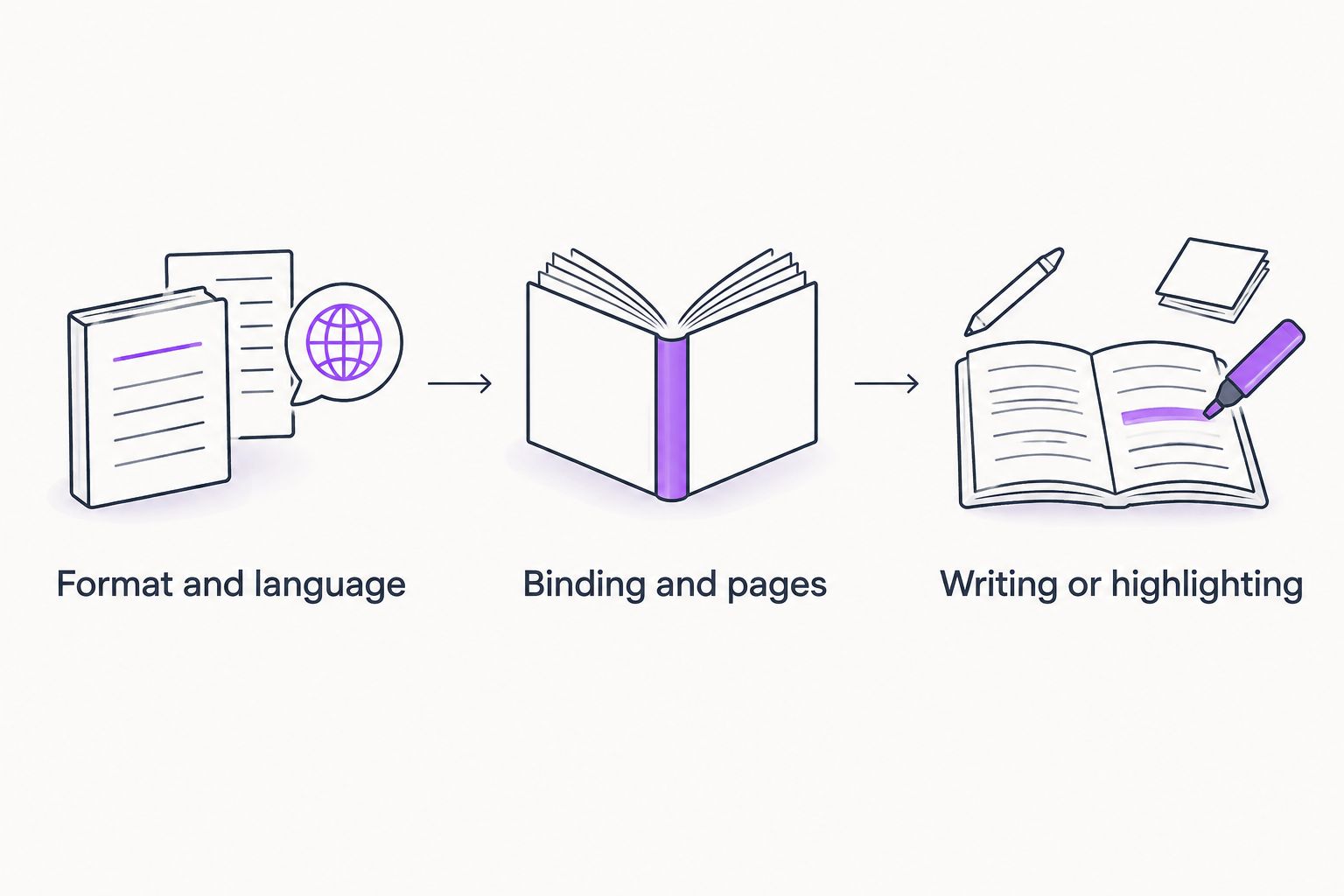
- Confirm the format and language.
- Check the stated condition of the binding and pages.
- Read disclosures about writing or highlighting.
- Confirm whether the edition is abridged if that matters to you.
- Distinguish a stock cover image from photographs of the copy.
6. Compare the complete order, not just the book
Set a spending limit before checkout, then compare the complete amount shown for the order. Include delivery charges and applicable taxes rather than judging affordability from the book alone. Check the seller’s current terms instead of assuming another shop’s policies apply.
For your 2026 book budget, compare a small order you genuinely want with a larger order containing uncertain choices. Adding an unwanted book does not make that book useful. Keep the decision tied to your reading plans, not the size of the parcel.
Allow yourself a shortlist of 3 books, then identify the strongest match. This keeps the comparison manageable while leaving room to reject a copy that does not meet your condition requirements.
- Compare the complete checkout amount.
- Read current delivery and return terms.
- Remove titles added only to fill an order.
- Check the final edition and condition again.
7. Try one book before collecting an era
Start with 1 novel from an unfamiliar setting before planning a shelf around it. After reading, note whether you liked the period itself, the author’s style, or the particular plot. Those are different reasons to choose your next book.
Flippin Pages Bookstore adds fresh finds weekly, so keep a short list of authors and settings you want to explore. Revisit that list when browsing, without assuming that a specific title will appear. The list helps you recognize a suitable book when you encounter one.
Choose a standalone novel if you want to avoid checking reading order. If you prefer a series, establish where the book belongs before buying.
- Record what worked after finishing the book.
- Separate interest in the era from interest in the author.
- Check reading order for connected novels.
- Keep a short wish list rather than buying every related title.
Compare historical settings by reading preference
The best era is the one whose story possibilities interest you. The options below are starting points, not guarantees about every novel set in a period. Use the description and any available excerpt to confirm the individual book’s focus.
| Setting or approach | Best for | What to look for | Key limitation |
|---|---|---|---|
| Ancient-world fiction | Readers drawn to unfamiliar institutions and beliefs | A clear central character and accessible background | The description alone might not reveal how much explanation the story provides |
| Medieval settings | Readers interested in households, religious life, or power struggles | A premise that identifies whose daily life the story follows | The era label does not tell you whether the focus is domestic or political |
| Regency settings | Readers seeking courtship shaped by social expectations | A description that makes the relationship’s role clear | A Regency setting does not automatically make a novel a romance |
| Victorian settings | Readers interested in class, work, and social change | A specific household, occupation, or community | A broad setting can hide a poor match in tone or pacing |
| Wartime settings | Readers interested in relationships under pressure | Clear information about the conflict and content | Difficult subject matter requires attention to your personal boundaries |
| Dual-timeline fiction | Readers who enjoy connections between past and present | A description that explains both starting situations | Switching timelines is unsuitable if you want to remain in one period |
If several rows appeal, return to your preferred story type. A reader seeking a central love story should compare relationship-focused descriptions, not buy every book carrying the same historical label.
Common mistakes historical fiction readers make
Choosing the era but ignoring the plot
An interesting period cannot substitute for a story you want to read. Before buying, explain the central premise in one sentence without naming the era. If that premise leaves you cold, choose another book.
Assuming every historical romance has the same focus
A historical setting, a romantic subplot, and a romance-centered novel are different things. Read the description for the relationship’s role, and avoid using the cover alone to decide what kind of book you are buying.
Buying a later series volume by accident
A familiar author name does not establish that a book stands alone. Check the title’s place in any connected series before ordering, especially when you want to meet characters and follow events in sequence.
Treating every edition as equivalent
Check the specific copy rather than relying on the title alone. Format, language, print size, and abridgment can matter more to your reading experience than whether the cover matches another book on your shelf.
Building a collection before testing your interest
Avoid turning a promising setting into a large shopping commitment. Read an initial choice, identify what you enjoyed, and use that information to make the next purchase more deliberate.
FAQ
What’s the best way to find affordable books for historical fiction readers?
Choose a story type and era first, then compare physical used copies by condition, edition, and complete checkout amount. A focused shortlist makes it easier to reject books that do not fit your reading interests.
Which historical era should I try first?
Start with an era connected to a subject you already enjoy, such as courtship, family life, work, or political conflict. Read the individual book description because an era alone does not establish its tone or plot.
Is historical fiction the same as historical romance?
Historical fiction is not automatically historical romance. If you want a relationship-centered story, check that the description makes romance central rather than presenting it as a secondary thread.
Should I buy a paperback or hardcover historical novel?
Choose the format that suits how you hold, carry, and store books. Check the specific edition and condition rather than assuming one format is always the better purchase.
How do I avoid spoilers while choosing a historical novel?
Use the publisher-style description and an opening excerpt when provided. Avoid detailed plot summaries if discovering the story’s turns matters to you.
Can I learn history from historical fiction?
Historical fiction can introduce a period, but fictional scenes are not historical evidence. Consult an author’s note when accessible and use nonfiction sources to investigate events that interest you.
Does Flippin Pages Bookstore offer physical used books?
Flippin Pages Bookstore sells physical used books, including fiction and romance, with fresh finds added weekly. Check individual listings before deciding whether a particular book suits your reading plans.
One last thing
Your favorite historical novel does not have to lead you to another book from the same era. The better clue might be its family relationships, mystery, or close attention to everyday life.
For your next 2026 purchase, write down what you want to feel or follow before naming a period. Choose the story first, use the era to narrow your search, and let the copy’s details decide the purchase.