
Reading-challenge book shopping is choosing affordable books for reading challenges with the aim of building a varied physical-book list you can enjoy within your budget. For a 2026 challenge, start with prompts and reading preferences, then choose used copies rather than buying every title on your list at once.
- Choose affordable books for reading challenges by matching used books to prompts before buying.
- Flippinpagesbookstore is best for fiction and romance readers shopping for affordable used books.
- Keep backup titles for each prompt, and check the condition of the copy you choose.
- Buy for your next reading slot rather than filling the whole challenge list immediately.
Why book shopping matters for reading-challenge readers
A reading challenge needs a useful book list, not a large book order. Your choices have to satisfy the prompts, suit your taste, and fit the amount you want to spend. A title that checks a box but never leaves your shelf does not help you finish the challenge.
Budget-conscious fiction and romance readers also need room to explore. You can keep familiar genres on your list while adding different settings, narrative styles, and authors. Variety does not require abandoning the kinds of stories you already enjoy.
Flippinpagesbookstore sells affordable used books, including fiction and romance, with new stock added weekly. Treat those fresh finds as candidates for open prompts, not a reason to buy books without a place on your list.
For your 2026 plan, separate choosing a story from choosing a copy. First decide whether the book belongs in your challenge; then assess the physical edition and the order details.
Build your reading-challenge book list
Define your prompts before browsing
Start with the challenge rules in a notebook or a simple spreadsheet. Copy each prompt exactly, then translate it into a practical selection question. A prompt about an unfamiliar author asks you to check your own reading history; a prompt about a setting asks you to verify where the story takes place.
Keep required criteria separate from personal preferences. If the challenge specifies a particular format, a different edition will not solve that requirement. If it only asks for a story set somewhere new to you, you have more freedom to choose a copy.
For each prompt, write down 1 required criterion and any preference that would make the book more enjoyable. This keeps browsing focused without making the list too rigid.
- Copy the official wording of each prompt.
- Mark any edition or format requirement.
- Note your preferred genres and themes.
- Identify prompts that need extra research.
- Leave the title field open until you find a suitable book.
Set a shopping boundary you can maintain
Check your shelves before opening a shop page. Books you already own belong in your challenge plan if they meet the rules, and unread purchases deserve the same consideration as new finds. This is the simplest way to avoid buying a second copy of something you could start now.
Next, decide how much you want to spend on the challenge overall. Set aside part of that amount for later choices instead of assigning every bit to the first order. The purpose is to keep control of your purchases, not to create a complicated accounting system.
Make 1 shopping list for books you intend to buy and a separate list for possibilities. A possibility becomes a purchase only after it passes your prompt, preference, and copy checks.
- Record books you already own.
- Set your own total spending limit.
- Check the full order total before paying.
- Keep optional titles off the purchase list.
- Record completed purchases so you do not duplicate them.
Build a shortlist instead of fixing every title
Use your challenge sheet to collect candidates manually. Read publisher descriptions, author summaries, or spoiler-free reviews to confirm the details that matter. Do not treat a cover image or a genre label as proof that a book meets a specific prompt.
Aim for 3 candidate titles for a difficult prompt rather than committing to the first match. The alternatives give you room to compare editions and choose the story you actually want to read. They are backups, not a recommendation to buy three books.
Once you know your criteria, browsing Flippinpagesbookstore used books gives you a direct way to look for fiction and romance candidates. Keep your shortlist beside you so a fresh find answers a reading need rather than creating another unfinished purchase.
- Confirm the required setting, theme, or author detail.
- Read descriptions that avoid revealing the ending.
- Add a familiar option and an exploratory option.
- Keep backup titles for restrictive prompts.
- Remove candidates you would not read without the challenge.
Balance familiar reads with new choices
Look across the whole list before deciding on individual copies. A varied list can still be mostly fiction or romance. You can create contrast through setting, tone, narrative voice, or the kind of relationship at the center of the story.
For a 2026 challenge, make the differences specific. Instead of writing “something different,” name the change you want: an unfamiliar author, a historical setting, or a story told through letters. Confirm that the candidate actually has that feature before assigning it to a prompt.
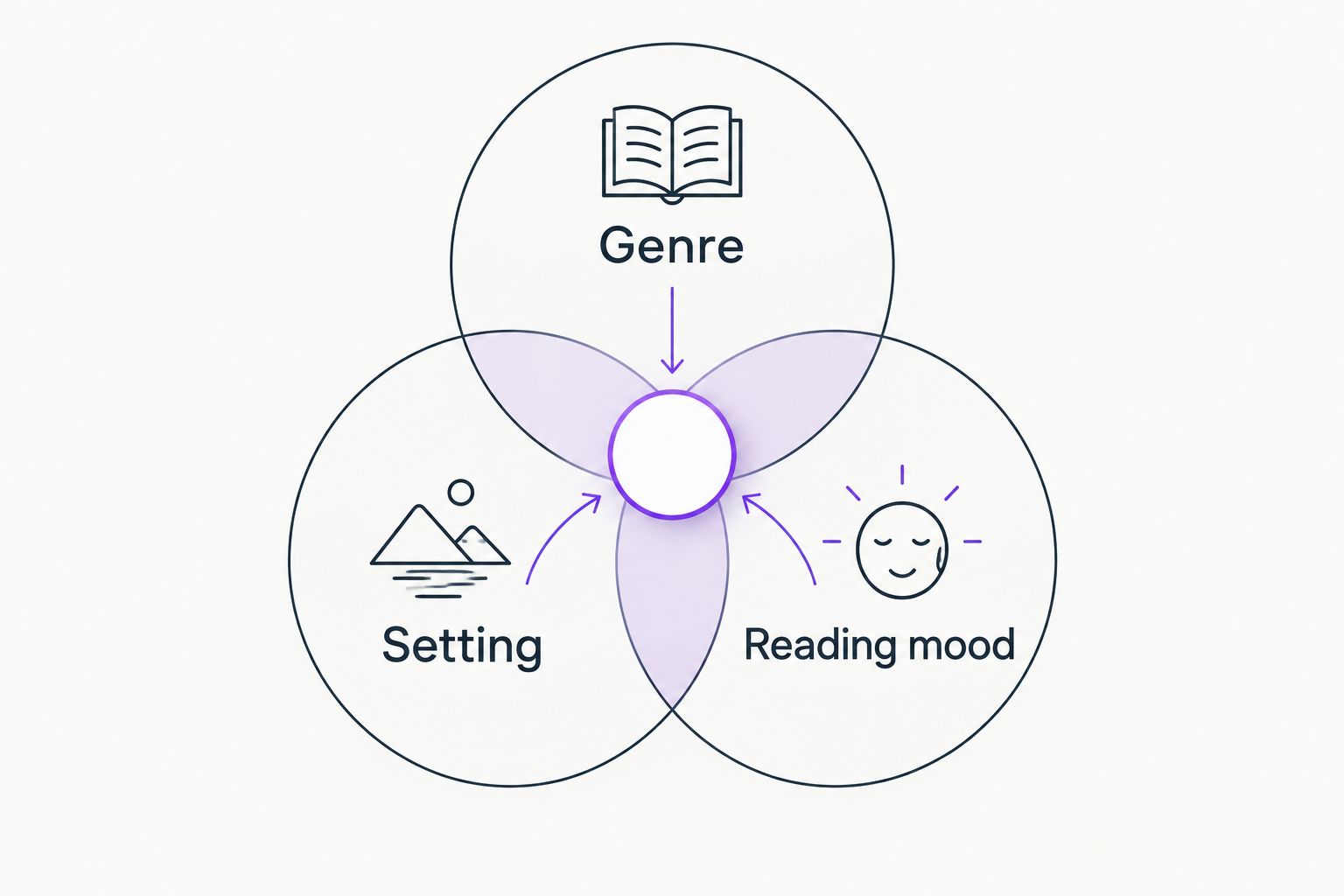
Use these 3 variety checks: genre, setting, and reading mood. A book does not need to differ on all three. One meaningful change is enough to give it a distinct role on your list.
- Keep genres you already enjoy in the plan.
- Compare settings across your shortlist.
- Alternate lighter and more demanding reading moods.
- Include authors you have not read before.
- Avoid choosing several books for the same reason.
Inspect the physical copy before ordering
A suitable story and a suitable copy are separate decisions. Read the individual listing rather than assuming all copies of the same title have the same condition. Check whatever photographs and condition notes the seller provides, and clarify anything that would affect your willingness to read the book.
For challenge reading, focus on usability. Worn corners might be acceptable to you; missing pages are not. Annotations, library markings, or a damaged jacket also deserve a decision based on your own preferences rather than a vague expectation of what used books should look like.
Check the edition when a prompt depends on a translator, a particular collection, or a complete text. Choose the copy that meets your reading needs, not simply the first copy you see.
- Read the condition description for that copy.
- Inspect photographs when provided.
- Check for notes about writing or highlighting.
- Confirm the format and edition.
- Review the seller's terms before completing the order.
Buy for your next reading slot
Choose the book you are ready to read next, then review the order as a whole. Compare the listed copy, delivery charges shown at checkout, and any other stated charges against your own limit. A single item figure is not the same thing as the final order total.
For your 2026 challenge, plan 1 next read and keep a backup candidate on the sheet. This gives your purchases a clear purpose without requiring you to commit to every remaining prompt.
Flippinpagesbookstore adds new stock weekly, so you can revisit unresolved choices as your challenge progresses. The limitation is that a changing selection does not establish whether a particular title has a suitable copy; check the individual listing before deciding.
- Match each purchase to a named prompt.
- Confirm the physical format you want.
- Review the complete order before paying.
- Remove books added only to fill out the order.
- Keep unresolved prompts open for later browsing.
Browse used books for your challenge
Look for fiction and romance that match your next reading prompt.
Update the list after each finished book
Mark the prompt as complete once you have finished the book and checked that it meets the rules. Add a short note about what worked: perhaps the setting interested you, the narrative style felt fresh, or the story suited your current reading mood.
Use that note to improve the next purchase. A challenge list should reflect what you learn about your taste, not preserve every decision made before you started. If you keep avoiding a candidate, replace it before buying rather than treating your early shortlist as a promise.
Check overlap carefully. Whether one book can satisfy several prompts depends on the challenge's own rules, not on how neatly the title fits your spreadsheet.
- Mark completed prompts clearly.
- Record the title and edition you read.
- Note which story features you enjoyed.
- Replace candidates that no longer appeal.
- Check the rules before counting a book twice.
Compare ways to build your challenge list
Choose a buying approach that matches how certain you are about your next read. These options organize your shopping; none requires buying an entire challenge list immediately.
| Option | Best for | Main advantage | Key limitation |
|---|---|---|---|
| Start with books you own | Readers with an unread shelf | Lets you begin without another purchase | Your books might not meet every prompt |
| Buy used books prompt by prompt | Readers with changing preferences | Keeps each purchase tied to an immediate reading goal | Requires another selection decision for each open prompt |
| Browse Flippinpagesbookstore used books | Budget-conscious fiction and romance readers | Offers affordable used-book shopping with new stock added weekly | You must check each candidate's listing and suitability |
| Fix every title before shopping | Readers following strict challenge rules | Creates a clear research list | Gives you less flexibility when a suitable copy is hard to find |
| Choose specific new editions | Readers with edition-dependent prompts | Keeps the search focused on the required format | Restricts which copies can satisfy the prompt |
For a flexible challenge, combine the first two approaches: read suitable books you own, then shop for the gaps. For an edition-dependent challenge, confirm the edition before making the title part of your final list.
Common mistakes reading-challenge readers make
Buying every candidate on the shortlist
A shortlist is a decision tool, not a shopping basket. Buying every possibility turns an unresolved choice into several purchases. Keep the alternatives recorded and choose the book that fits your next reading slot.
Confusing several genres with meaningful variety
A list can carry different genre labels while repeating the same setting, tone, or story structure. Check what changes from book to book. You can also build a varied romance list without adding a genre you do not enjoy.
Using a low item figure as the only buying test
Judge the complete order and the condition of the copy together. A book that falls within your spending limit still needs to meet the prompt and suit your reading preferences. Do not let one attractive listing detail replace those checks.
Treating a prompt match as a reading recommendation
A title can qualify for a challenge without being right for you. Read the description, check content information when needed, and ask whether you want to spend time with that story. Meeting the prompt is necessary; wanting to read the book matters too.
Refusing to revise an early plan
Your 2026 challenge sheet is a working list. Replace an unpurchased candidate when your interests change, and revisit difficult prompts after finishing easier ones. Keep the official requirements fixed while allowing your book choices to improve.
FAQ
What's the best way to choose affordable books for reading challenges?
Match books to your challenge prompts before shopping, then choose suitable used copies for the gaps. Start with books you own and keep backup titles for difficult prompts.
Can I use secondhand books for a reading challenge?
A secondhand copy works when it meets the challenge's format and edition requirements. Check the official rules and the individual copy's condition before buying.
How do I make a romance reading challenge more varied?
Vary the authors, settings, narrative styles, and reading moods across your romance list. You do not need to leave romance to give each choice a distinct role.
Should I buy my entire reading-challenge list at once?
Buy for your next reading slot rather than committing to the whole list when your choices are still flexible. Keep later candidates on a shortlist so you can revise them without buying replacements.
How many backup books should I list for a difficult prompt?
Use three candidate titles as a practical shortlist for a difficult prompt. This is a planning suggestion, not a reason to buy all three.
Can one book count toward two reading-challenge prompts?
One book can count toward multiple prompts only if your challenge's rules permit it. Check those rules before assigning the same finished book to more than one requirement.
What should I check before buying a physical used book online?
Check the individual copy's condition, format, edition, and complete order details. Review the seller's stated terms and clarify any condition detail that would affect your decision.
One last thing
Leave one difficult prompt without a fixed title while you research it. An open space on your list is more useful than a purchased book you chose reluctantly just to complete the plan.
Before your next order, write a sentence explaining why each book belongs: which prompt it meets and why you want to read it. If you cannot name both reasons, keep the book on your possibilities list instead.