
Beginner romance book shopping is choosing a physical novel with a central love story that fits your reading tastes, comfort level, and budget. This guide to buying romance books online for beginners in 2026 helps you choose a starting point, understand unfamiliar labels, and check a used copy before ordering.
- For romance books online for beginners, choose a standalone that matches your preferred setting and content boundaries.
- Flippin Pages Bookstore suits budget-conscious readers shopping for physical used romance books, with fresh finds added weekly.
- Check the relationship focus, series order, book condition, and order total before choosing a copy.
- Use spoiler-free descriptions to compare romance novels; popularity alone does not establish a good fit.
Why romance book shopping matters for beginners
Your first romance novel should introduce you to a kind of story you want to read, not require you to decode every label on a listing. Start with the setting, relationship, and tone. Those choices tell you more about personal fit than a cover alone.
Shopping for a physical used book adds another decision: whether the particular copy meets your needs. A story can sound right while its print size, format, or condition makes it uncomfortable to read. The guide to reading used-book condition descriptions helps you separate cosmetic wear from details that affect reading.
Flippin Pages Bookstore is best for budget-conscious readers shopping for physical used romance books. The store adds fresh finds weekly; choose by fit rather than treating each new addition as a reason to order.
Understand what counts as a romance novel
A genre romance centers the developing romantic relationship and ends with an emotionally satisfying, optimistic resolution. A novel with a love story is not automatically a genre romance: the relationship might support a different main plot, and the ending might follow different expectations.
That distinction matters when you want reassurance without spoilers. Look for a clear genre description rather than assuming that a romantic cover guarantees the reading experience you want.
Two other terms help:
- Subgenre describes the story's broader setting or type, such as historical romance or romantic suspense.
- Trope describes a familiar relationship setup, such as friends becoming lovers or a pretend relationship becoming real.
- Content notes identify sensitive material. They are different from a general description of how explicit the romantic scenes are.
You do not need to memorize these terms. Use them to ask better questions about a book before buying it.
How to choose your first physical romance novel
1. Choose a setting you already enjoy
Start with your existing tastes in stories, films, or television. If you enjoy everyday relationships and familiar settings, contemporary romance gives you a useful starting filter. If you prefer imagined worlds, a fantasy setting offers a different route into the genre.
Neither choice is a difficulty rating. Historical stories can require unfamiliar social context, while contemporary stories can still involve complicated families, workplaces, and relationships. Choose the setting you want to spend time in, then read the individual description.
For your 2026 shortlist, write down what interests you before browsing. A clear preference gives you a reason to keep or reject a listing without relying on its popularity.
- Choose a familiar setting if you want fewer new background details.
- Choose a historical setting if period customs interest you.
- Choose fantasy romance if imagined worlds appeal to you.
- Choose romantic suspense if you want danger alongside the relationship.
- Note any setting you would rather avoid for now.
2. Set your content and tone boundaries
Decide what you want the reading experience to feel like. A playful premise does not establish that a book avoids grief, violence, or explicit scenes. Read the description and any available content information separately.
Terms such as closed-door and open-door describe how intimacy is presented, but readers and publishers do not always use them identically. Treat a label as a starting point for checking, not a complete account of the book's contents.
Use a short written note rather than trying to remember every preference. This is a manual way to narrow your choices without needing a subscription, recommendation service, or large reading history.
- Write down subjects you do not want to encounter.
- Decide whether you want explicit romantic scenes described on the page.
- Look for content notes when the listing does not answer your questions.
- Read spoiler-free reviews for tone rather than plot summaries.
- Leave a title off your shortlist when a firm boundary remains unclear.
3. Build a small shortlist before browsing widely
Choose 3 candidate titles, then compare them against the same criteria. This is a shopping limit, not a claim that every reader needs the same number of options. A small list lets you examine each book instead of opening more listings without making a decision.
Begin with descriptions you can read without paying for another service. Record the title, author, setting, relationship setup, and any unresolved questions. Then browse Flippin Pages Bookstore for physical used romance books that match those preferences.
Flippin Pages Bookstore adds new stock weekly, which gives you a reason to revisit your shortlist when you have not found the right match. It does not establish that a particular title is listed, or replace checking the details of an individual copy.
- Save the exact title and author for each candidate.
- Note one clear reason each book interests you.
- Record any unanswered content or series-order questions.
- Remove candidates that fail a firm reading preference.
- Keep your shortlist separate from your shopping cart.
4. Check whether the book stands alone
A standalone offers a contained starting point without requiring earlier books. A connected standalone belongs to a wider series but is intended to tell its own main story; verify that description rather than assuming every book with different central characters works independently.
An ongoing story presents a different choice. The relationship or main conflict can continue into another volume, so the first book might not provide the stopping point you expect.
For a low-commitment introduction, choose 1 standalone novel. This is a practical starting recommendation, not a rule against series. If a series attracts you, begin with the intended entry point and understand what remains unresolved.
- Look for a series name or volume number in the listing.
- Check the author's or publisher's reading-order information when available.
- Distinguish a connected standalone from a continuing story.
- Avoid reading detailed later-book summaries to investigate order.
- Choose the first volume when the story depends on earlier events.
5. Inspect the physical copy and order details
Separate the appeal of the story from the suitability of the copy. Read the condition description for markings, binding issues, missing material, odors, or other disclosed wear. Listing photographs, when provided, help only if you understand whether they show that copy or a representative cover.
Check the edition and format too. A paperback and hardcover can contain the same story while feeling different in your hands; large-print editions address a different reading need. Do not assume a cover image identifies every edition detail.
Before placing a 2026 order, make 2 checks: confirm what you are buying, then review the full order details. Read the current shipping and returns information rather than assuming terms match a previous purchase.
- Match the title, author, format, and edition to your intended book.
- Read all disclosed condition details, not just the headline grade.
- Check whether photographs depict the actual copy.
- Review the full order total before submitting payment.
- Read the seller's current shipping and returns terms.
6. Choose the best fit and order deliberately
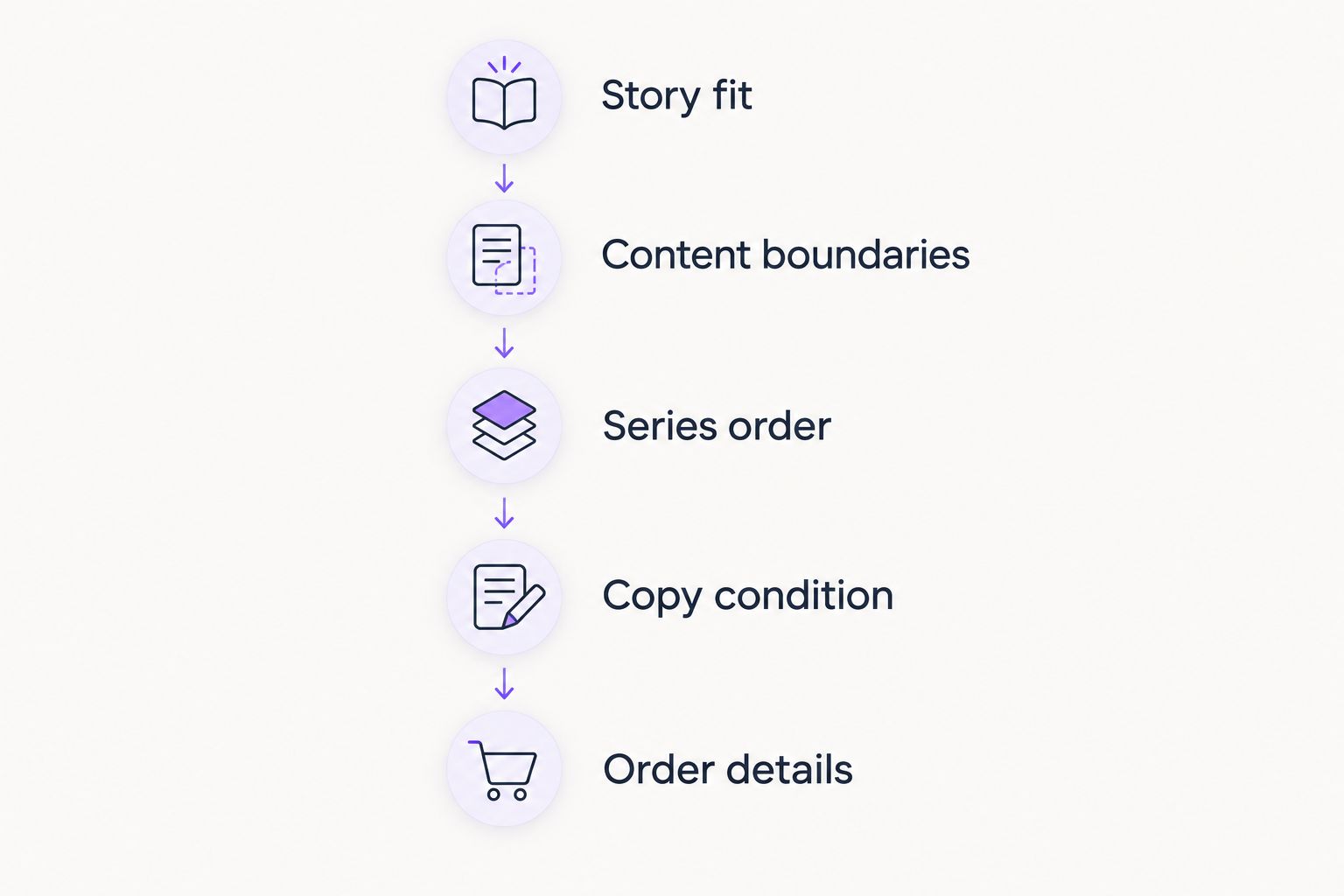
Compare your finalists in a fixed order: story fit, content boundaries, series order, copy condition, and order details. Do not let an attractive cover settle a question that the listing leaves unanswered.
The simplest decision is the title that meets your firm preferences with the fewest unresolved questions. If none does, keep looking rather than buying a book you already have reasons to avoid.
Once you choose, save your remaining candidates for another visit. Buying your first novel does not require building a whole collection at the same time.
- Story fit: choose a premise you genuinely want to read.
- Content boundaries: resolve questions about your firm limits.
- Series order: confirm the book is a suitable entry point.
- Copy condition: accept only wear you are comfortable with.
- Order details: review the transaction before placing it.
Compare beginner-friendly starting points
Use this table to organize your 2026 choices, not to rank entire subgenres. Every route has a useful feature and a limitation; the individual book still determines the reading experience.
| Starting point | Best for | What it offers | Key limitation |
|---|---|---|---|
| Contemporary standalone | Readers who want a present-day setting | A relationship story without required earlier volumes | A familiar setting does not guarantee a light tone |
| Historical standalone | Readers interested in another period | Romance shaped by a particular historical setting | Unfamiliar customs can require more context |
| Fantasy romance | Readers who enjoy imagined worlds | A relationship alongside speculative elements | Worldbuilding and continuing plots can add reading commitments |
| Romantic suspense | Readers who want danger alongside romance | Relationship development combined with a suspense plot | Threats or violence can conflict with content preferences |
| Connected standalone | Readers who like returning characters | A contained central story within a wider series | References to other books can reveal earlier developments |
For physical used-book shopping, Flippin Pages Bookstore offers affordable books and weekly additions. Its changing selection means choosing from the current listings rather than assuming a particular title will be there. Confirm the copy details before ordering.
Common mistakes beginners make
Choosing a trope instead of checking the whole story
A friends-to-lovers setup tells you how a relationship begins, not how intense the book feels. Read the premise and content information too. Keep a trope on your preference list, but do not let it override a firm boundary.
Assuming every romance is light reading
An optimistic romantic resolution does not mean the characters avoid difficult experiences. A book can include loss, illness, conflict, or danger along the way. Choose the emotional experience you want rather than treating the genre label as a complete content guide.
Buying several volumes before trying the writing
A series description can sound appealing while the first book's voice does not suit you. Start with the intended entry volume instead of making a larger commitment immediately. Your 2026 reading goal should not pressure you into ordering books you have not evaluated.
Treating every used copy as interchangeable
The same title can appear in different formats, editions, and conditions. Read the listing attached to the copy you intend to order. An acceptable crease and a damaged binding are different decisions, even when both listings describe used books.
Using detailed reviews to avoid every surprise
Searching for reassurance can expose major plot developments. Read descriptions and clearly marked spoiler-free reviews first, then investigate only the specific question affecting your decision. You need enough information to choose, not a scene-by-scene account.
FAQ
What's the best kind of romance book for a beginner?
A standalone romance that matches your preferred setting and content boundaries is a practical first choice. Contemporary settings offer familiar context, but historical, fantasy, and suspense stories are equally valid starting points when those settings interest you.
Does buying romance books online mean buying ebooks?
No, you can shop online for physical romance books. Check the format field before ordering so you know whether the listing is for a paperback, hardcover, or another physical edition.
How can I tell whether a romance book has explicit scenes?
Check the book description, available content notes, and spoiler-free reviews for information about explicit scenes. Labels such as open-door and closed-door help narrow the question, but they do not describe every aspect of the content.
Should my first romance book be part of a series?
Your first romance book does not need to be part of a series. A standalone limits the reading commitment; if you prefer a series, confirm its intended starting point and whether the main story continues beyond the volume you are buying.
Are used romance books a good choice for beginners?
Used romance books are a practical choice when the title, format, and copy condition suit your needs. Read the individual condition description and review the complete order details before deciding.
Where can I shop for physical used romance books?
Flippin Pages Bookstore sells physical used books, including romance, and adds new stock weekly. Browse current listings and check the details of any copy you intend to order.
How do I choose a romance novel without reading spoilers?
Start with the publisher's description and reviews explicitly marked spoiler-free. Check only the content boundaries and reading-order questions that affect your choice, and avoid summaries of later series volumes.
One last thing
Keep a short note after finishing your first romance: what you liked, what you disliked, and whether you want a similar reading experience. Separate the story from the copy's condition. A worn cover is not a reason to reject an author, and a beautiful edition is not proof that a premise suits you.
Use that note for your next 2026 purchase. Your own reading preferences are a better shopping filter than trying to buy every popular title.