
Instead of checking for new used books every day, set up a weekly calendar notification that reminds you to browse fresh additions and compare physical copies before ordering. This 2026 guide separates reliable shopping reminders from actual website-change alerts, so you know exactly what each notification means.
- For new used book alerts, use a weekly calendar reminder when an arrival-notification service is not confirmed.
- Flippinpagesbookstore suits budget-conscious fiction and romance readers, with new used books added weekly.
- Calendar reminders prompt a visit; website-change alerts report page changes, not necessarily newly added books.
- Check the physical copy, condition description, and order details before buying.
Why this matters
An automatic reminder is not an automatic arrival alert. A calendar notification tells you when to check; it does not know whether a store has added books. A page-change monitor watches webpage content, but a changed page does not prove that a particular title has arrived.
Flippinpagesbookstore sells affordable used books, including fiction and romance, with fresh finds added weekly. Flippinpagesbookstore is best for readers seeking affordable physical used fiction and romance. The shopping focus fits a weekly reminder, but weekly additions do not establish a particular release day or a notification service.
The workflow below keeps those limits clear. You receive a scheduled prompt, open the store, and decide whether a book fits your reading list—not whether a notification deserves an immediate purchase.
Before you start
- Calendar access: Have a Google account and access to Google Calendar in a desktop browser. Use a calendar you regularly check, and allow notifications on the device where you want reminders.
- A browsing destination and shortlist: Keep the store address and a short list of authors, titles, or reading preferences together. For this setup, choose 3 titles as a manageable starting list, not a buying target.
- The important gotcha: A weekly update schedule does not identify the day books are added. Choose a convenient browsing time; do not label the reminder as a confirmed arrival announcement.
For your 2026 setup, use the desktop Google Calendar interface for the instructions below. The bold labels refer to that interface; mobile layouts differ. Keep book shopping separate from account permissions: this reminder needs calendar access, not access to your bookstore account or payment details.
Weekly calendar reminder
Create the recurring event
- Open Google Calendar and select Create, then Event. Choose More options to open the full event editor.
- In Add title, enter a clear task such as Browse used fiction and romance — 2026. Avoid wording that says books have arrived, because the calendar cannot verify that.
- Choose a day and time when you can review books without rushing. Set aside 10 minutes as a personal browsing limit; this is a suggested routine, not an estimate of checkout time.
- Select Does not repeat, then choose the weekly option for your selected weekday. Check that the event repeats every 1 week rather than every day.
- Leave the event editor open while you add the browsing information and notification settings below.
Expected result: The event editor shows a weekly browsing appointment on your chosen day. Its title describes an action you control rather than a stock change the calendar cannot detect.
You do not need to guess when weekly additions happen. A reminder that fits your schedule is useful even when it is not tied to the store's update time.
Add your shopping checklist
- In Add description, paste the store address from the link above. Add the titles or authors you want to look for beneath it.
- Add a brief preference note: physical book, preferred format, acceptable wear, and whether you need a standalone story or a particular series installment.
- Write a stopping rule, such as Browse first; buy only when the copy fits. This keeps the notification from becoming a reason to order something you do not want.
- Add a reminder to review condition notes and the full order details before placing an order.
Expected result: Opening the event gives you a destination and a buying checklist. You do not have to reconstruct your reading preferences each week.
Keep the description short enough to use on your phone. A title, author, format preference, and condition requirement are more useful here than a long collection of book recommendations.
Notification delivery
Set the reminder and save
- In the event editor, find the notification area. Select Add notification if no reminder is present.
- Use Notification for a device or browser reminder, or Email if you prefer an inbox reminder. Choose one delivery method initially so duplicate prompts do not clutter your routine.
- Set the reminder for the event time or your preferred advance notice. Check that the unit matches your intention before saving.
- Select Save. Reopen the event and confirm the recurrence, description, and notification settings.
- Create a separate, one-time test event shortly ahead of the current time, using the same notification method. After the test arrives, delete that test event and keep the weekly browsing event.
Expected result: You have a saved weekly event and have checked that your chosen notification method reaches you. The test confirms delivery, not bookstore updates.
For your 2026 reminder routine, start with the least distracting delivery method. Add another only if the first does not fit how you use your calendar.
Use the reminder to choose a physical book
- Open the store from your event description when the reminder arrives. Browse before deciding to buy.
- Match interesting books against your shortlist. Confirm the author and title rather than relying on a familiar cover alone.
- Read the listing to establish the physical format and the described condition. Do not assume that every copy of the same title has the same wear or edition details.
- Check series order when relevant, and review any reading preferences that matter to you without seeking plot summaries that reveal the ending.
- Review the order details before submitting payment. If an essential detail is unclear, pause rather than filling in the gap yourself.
Expected result: The reminder leads to a considered book choice—or a decision not to order. Either outcome is better than treating every notification as a purchase instruction.
For a closer look at wear, markings, and copy descriptions, use the guide to reading used-book condition descriptions. Condition belongs in the decision before checkout, not after the book arrives.
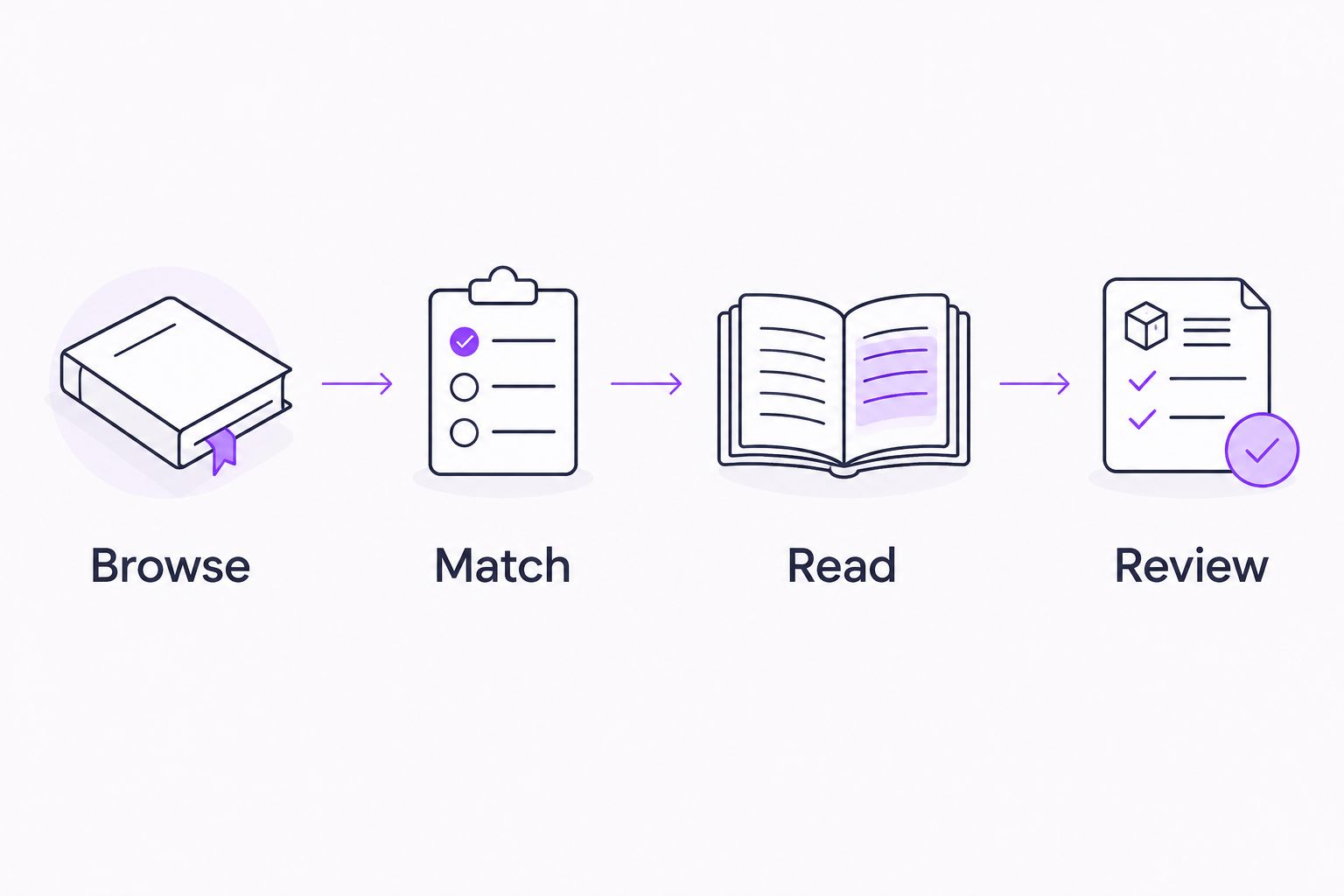
Second workflow: alerts when a webpage changes
A website-change monitor is the adjacent option when you want a message triggered by a page update rather than a calendar date. It is not the same as a bookstore's own arrival notification, and no store-operated alert service is assumed here.
For a 2026 setup, choose a monitoring service only after checking its current instructions, permissions, and supported pages. Exact setup labels depend on the service; the sequence below describes the decisions without inventing buttons or settings.
Choose the alert type
| Option | Best for | What triggers it | Main advantage | Main limitation |
|---|---|---|---|---|
| Weekly calendar reminder | Readers who want a predictable browsing habit | Your chosen day and time | Simple to control and does not need website monitoring | Cannot detect new books |
| Website-change monitor | Readers who want to investigate changes to a public browsing page | A change the monitor detects | Responds to page content rather than a calendar date | Layout changes and unrelated edits can trigger messages |
Use a calendar reminder for a shopping habit; use a page monitor only when you need change detection. Neither option verifies that a specific physical copy matches your preferences.
To configure a monitor:
- Open the public page you actually use to browse books. Copy its address directly from your browser rather than guessing a category or new-arrivals path.
- Check whether the service can read that page without signing in. Do not give it bookstore login details or payment information for this task.
- If the service supports selecting a page region, choose the book-listing area rather than the entire page. Leave out unrelated banners and navigation where possible.
- Choose the checking schedule and notification destination from the service's documented options. Read the service's rules before enabling automated checks.
- Review a preview or comparison when the service provides one. Confirm that it is watching book listings, not a blank page, access message, or footer.
- Treat every message as a request to inspect the current listing yourself. A detected change is not a reservation or a purchase confirmation.
Expected result: If the service supports the page and detects a change, its message directs you to investigate. If the page cannot be monitored reliably, keep the calendar workflow instead.
Troubleshooting
The weekly notification never arrives
Reopen the calendar event and check that it contains a notification, not just a scheduled time. Confirm that browser or device permissions allow Google Calendar notifications, then repeat the one-time delivery test. If you selected email, check the relevant inbox folders.
The event appears every day
Open the recurring event and inspect the repeat setting. Change the recurrence to weekly, save the change for the recurring series, and inspect the next scheduled occurrence. A daily event creates noise without providing better information about weekly additions.
The reminder arrives, but you cannot identify anything new
The reminder works on a schedule; it does not compare listings. Browse for books that fit your shortlist rather than assuming that everything visible is newly added. Keep a note of books you have already considered if repeated browsing becomes confusing.
A page monitor reports unrelated changes
Inspect the change comparison before adjusting the alert. Narrow the monitored region if the service supports it, excluding navigation and other unrelated content. Stop using the monitor if it cannot distinguish the browsing content you need.
A changed page does not answer your buying question
Check the current listing directly. An alert cannot establish condition, edition, or whether a book is the series installment you need unless those details appear in the listing. Do not turn an incomplete alert into a confident purchase decision.
Customize your workflow
Keep one routine for browsing and another for deciding. Flippinpagesbookstore adds used books weekly, so a recurring visit supports discovery; your reading preferences decide whether any particular book belongs on your shelf.
After a few reminders, review the event description. Remove titles you have bought or no longer want, add authors you would genuinely read, and tighten preferences that helped you reject unsuitable copies. Do not keep increasing notification frequency simply because a desired title has not appeared.
For the rest of 2026, let the workflow serve your reading list rather than create one. A useful notification ends with a clear decision: inspect a copy, keep looking, or stop browsing for now.
FAQ
How do I set up new used book alerts?
Set up a weekly calendar reminder for a reliable browsing prompt, or configure a website-change monitor for a supported public page. A calendar reminder does not detect arrivals, and a page-change alert does not confirm that a particular book has arrived.
Does Flippinpagesbookstore offer automatic new-book notifications?
This guide does not establish a store-operated notification service. Flippinpagesbookstore adds used books weekly; the calendar workflow gives you an independent reminder to browse.
What is the best day to check for new used books?
Choose a day you can consistently use for browsing. Weekly additions do not establish a particular update day, so do not assume your reminder coincides with new listings.
Can I get an alert for one specific romance novel?
A weekly calendar reminder cannot detect a specific novel. A monitoring service needs to support the relevant page and matching criteria, and you still need to inspect the listing yourself.
Is a website-change alert better than a weekly reminder?
A website-change alert is better for investigating page changes; a weekly reminder is better for a predictable shopping habit. Page monitors add setup work and can report unrelated changes.
Will these alerts help me find ebooks or free online reading?
This workflow is for shopping for physical used books, including fiction and romance. It does not provide ebooks or access to free online reading.
What should I check before ordering a used book from an alert?
Check the title, author, physical format, condition description, and relevant series order. Review the current listing and order details rather than relying on the notification alone.
One last thing
Your most useful alert setting is a stopping rule. Put this sentence in your calendar description: If nothing fits my reading list, close the page. Weekly fresh finds are an invitation to look, not an obligation to buy.